
Improve the way players train and adapt by learning how to structure and plan training to maximise every second.
There are several considerations that coaches and staff should make when organising training, whether it be daily, weekly, or even monthly training, as there are many factors that can influence players’ performance. In this section we will outline two key considerations to planning training, why they are so important, and the effect that they can have on performance.
Interference Effect
As is the case with many sports, soccer requires a high level of both strength and endurance. A very popular way of ensuring players are improving and maintaining both strength and endurance levels is to use a training method known as ‘concurrent training’. Concurrent training is simply when both strength and endurance training is programmed into the same schedule. This may seem a perfect idea in theory; players are receiving both training methods required, and therefore maximising training efficiency. But is this the whole story?
Research shows us that concurrent training needs to be carefully programmed to maximise its benefits, due to what is known as the ‘Interference Effect’ or ‘Concurrent Training Effect’. This effect is essentially a compromised adaptation to training due to the two different training methods. The reasoning behind this requires some complex molecular physiology, so for ease of understanding we will be simplifying the science so that the core principles can be best understood (links to research discussing this topic in more depth are available for those who wish to dive into the science).
Training causes a stress response within the body, and adaptations to training are caused by stress signalling, causing activation and inhibition of molecular pathways within the body. These pathways cause changes to gene transcription and translation, and other cell functions. As we already know, different methods of training lead to different adaptations, and therefore activate and inhibit molecular pathways differently too. High volumes of low-moderate intensity continuous training activate and inhibit different pathways to strength training, and this is the main cause of the interference effect.
The figure below lays out the main activation and inhibition pathways for both strength and endurance training, and the effect on one-another.
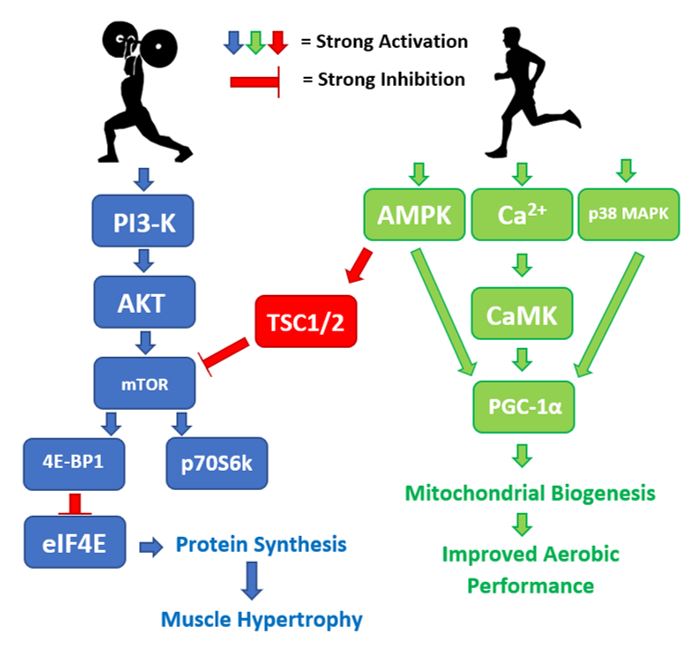
Continuous endurance exercise leads to a large increase in activation of AMPK, which de-activates the AKT-mTOR pathway, via the activation of TSC1/2. This de-activation causes muscle protein synthesis to be inhibited. The increased activation of AMPK also increases mitochondrial protein synthesis through an increased activation of PGC-1α, and an increase in protein degradation through activation of other molecules. The take-away from this is that continuous endurance training inhibits muscle protein synthesis, so when players are doing both strength and endurance training in a concurrent model, they are not able to maximise the adaptations as the training methods affect each other [21][39].
However, continuous endurance training is not the only way to improve players’ aerobic performance; what about High-Intensity (HIIT) and Sprint Interval Training (SIT)?
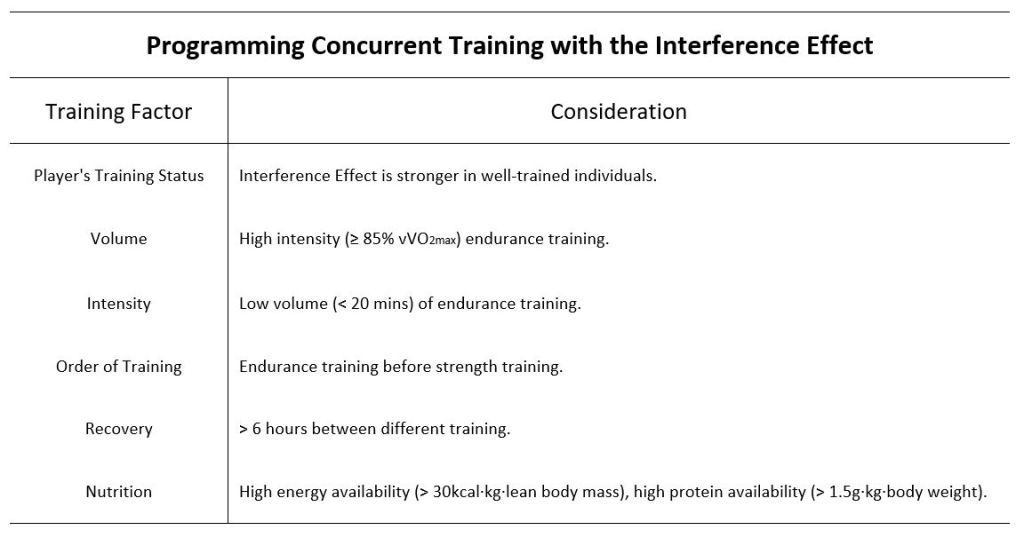
The use of low volume (< 20 min), high intensity (≥ 85% vVO2max) HIIT or SIT as aerobic training in place of continuous endurance training in a concurrent model leads to a significantly lower activation of AMPK. This is turn results in lower negative effects on strength training, while still providing the same aerobic adaptations as continuous endurance training.
So, it has been shown that combining endurance and strength training into the same programme can have a negative blunting effect on strength training adaptations. If this is the case, then how should we programme concurrent training?
To maximise the adaptations from concurrent training and minimise the interference effect on players the following considerations should be made:
1 – Training volume when programming.
2 – Using low volume, high intensity HIIT or SIT as endurance training.
3 – Different training methods should be separated by at least 6 hours, as this is how long it takes for AMPK levels to return to baseline.
4 – Endurance training should be completed before strength training so that pathway activation has time to return to baseline, or at least reduce, therefore reducing the inhibiting effect.
5 – The interference effect seems to be stronger in well-trained individuals, so this should be considered depending on the level and training experience of players.
What does the research say? [18]
Research has looked at the way that training is programmed in elite youth soccer players, and the picture below shows how each different programme was carried out. One group completed strength training before endurance (soccer) training, and one group completed the strength training afterwards. This was completed 2 days per week, for 5 weeks.

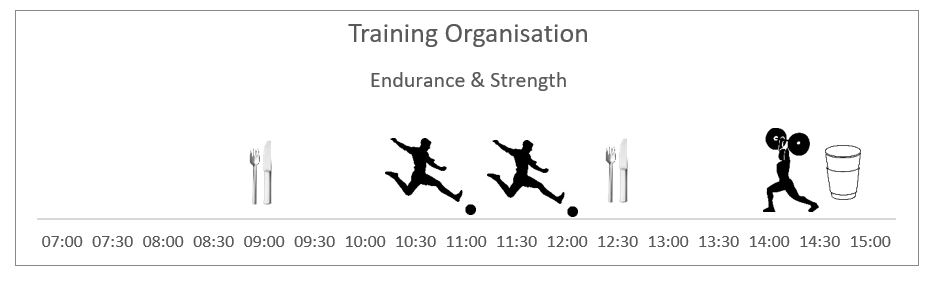
The group that had strength training after endurance training (Image 2) showed a clinically significant improvement in physical performance characteristics associated with match performance. This shows us that even in elite soccer players the interference effect is reduced when strength training is done after endurance training.
Periodisation
This section will discuss the general concept of periodisation and how you can use it to maximise players’ performance. Periodisation can be applied to any specified time frame, and is usually broken down into macro-, meso-, and microcycles (largest to smallest, respectively). In soccer, a macrocycle will usually span one season, with mesocycles being months, and microcycles being a week in length. It is important to plan physical training alongside soccer-specific training so that adaptations can be optimised.
These models will inevitably change considerably throughout the season, as matches are rescheduled, cancelled, or added to the original schedule. Below is an example of how a microcycle might be planned based on two different scenarios (6 days, and 5 days between matches).
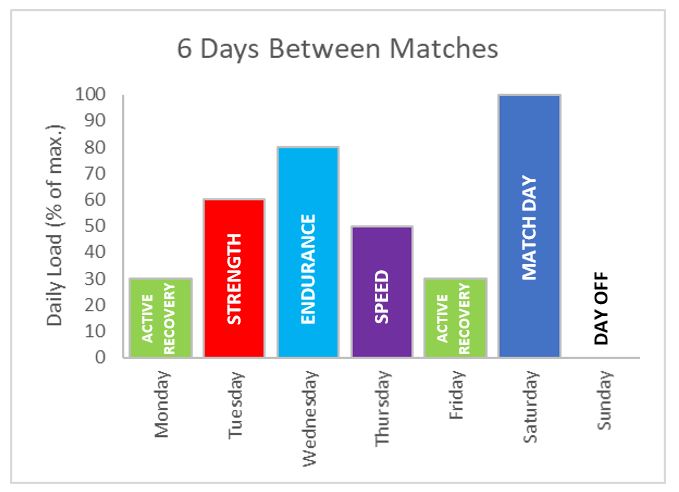
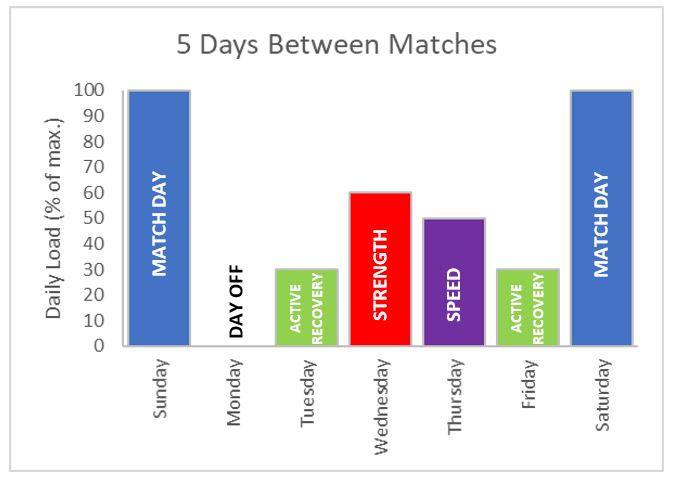
It is important to allow players to have adequate recovery time after matches, whilst also aiming to maintain and improve physical performance throughout the season.
 Science of Soccer