
Broaden and enhance your knowledge of the bedrock to any successful athlete; nutrition.
Weekly soccer schedules are typically highly demanding in terms of energy expenditure, and professional players can have daily energy expenditures of up to around 4000 kcal per day over a weekly period [2]. We should be careful, however, when designing and prescribing players’ energy intakes, as values are specific to individuals, and will be affected by body size and composition, playing position, team tactics and playing style, and environmental conditions (e.g. heat and humidity) [45]. It is also recommended that players balance their daily energy intakes depending on the training or match schedule of that day, for example, a higher energy intake on a double training session day, and a lower energy intake on a rest day. Players should aim to split their daily energy intakes of Carbohydrate (CHO), Protein, and Fat in the following percentages.

This is a rough approximation of how an average training day may be split, we will however discuss specifics of nutritional recommendations for players in more detail. Players should have a diet high in CHO, from nutrient-dense, complex CHO foods and should aim for 7 – 10 g per kg of body weight per day (this should rise to 12 g on heavy training days and match days) [10]. As with CHO intake, protein intake is very important to optimising performance, as it plays a vital role in recovery and training adaptation processes. Players should aim to consume 1.2 – 2.0 g per kg of body weight per day, which equates to roughly 20% of total daily energy intake. As well as total quantity of protein intake, the timing and content of protein is important. Studies have shown that muscle protein synthesis is greatest when 4 x 20 g of protein is taken every 3 hours after exercise [3]. This means players should looks to consume protein in a pattern of 0.4 g per kg of body weight for 4 meals per day. Fat is also very important to include within a player’s diet as it is needed for fat-soluble vitamins (vit A, D, E, and K) as well as essential fatty acids that all contribute towards optimal bodily function. Fat should contribute around 20% of a player’s total daily energy intake, and while players should focus more on achieving CHO and protein targets, fat intake can be worked out as the remaining calories needed once these targets have been met.
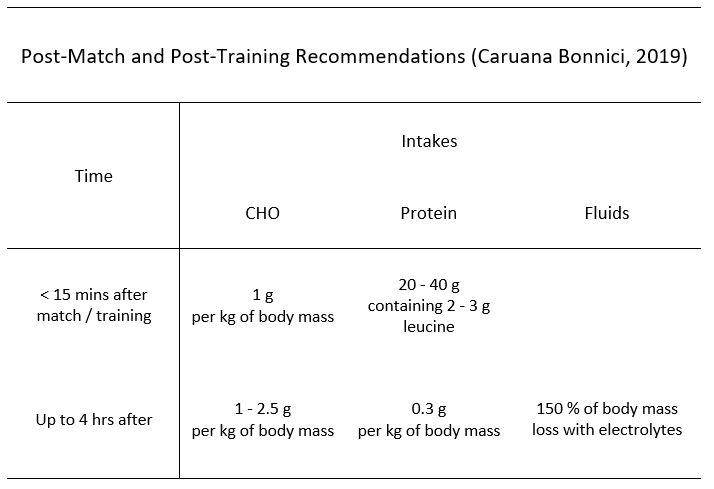
The following tables give research-based recommendations as to CHO, protein, and fluid intake values for pre-exercise and post-exercise scenarios for soccer players.

Recently, it has been shown that the best way to improve younger (14 – 19 years old) soccer players’ dietary intakes was to improve their nutritional knowledge through education, and to set achievable goals for players [43]. This will begin to remove reported barriers to optimal diets and will allow players to make informed dietary choices for the rest of their playing career, which will allow for optimal performance, decreased injury risk and ultimately a longer career in the game for players, and a higher percentage of players to be at match fitness for a longer amount of time for coaches.
 Science of Soccer