
It is easy to get lost in the sea of supplement marketing; but how do these supplements work, and can they aid soccer performance?
The use of dietary supplements is very common among soccer players at all levels of the game, and they can offer many practical benefits. Supplements can offer players convenient and time-efficient ways to reach their daily energy intake goals, especially during congested schedules, double training days, or away matches where travel can impact nutritional choices.
However, there are concerns with dietary supplements as up to 25 % of supplements have been shown to be contaminated with substances that are prohibited by the World Anti-Doping Agency (the full list of banned substances can be found here) [7].
The American College of Sports Medicine, along with the Academy of Nutrition and Dietetics and Dieticians of Canada have divided dietary supplements into three categories [44]:
- Sports Foods (e.g. sports drinks, sports bars)
- Medical Supplements (e.g. iron and vitamin D tablets)
- Specific Performance Supplements (e.g. caffeine, creatine)
In this section we will discuss the uses, benefits, and recommendations of supplements that fall into these three categories.
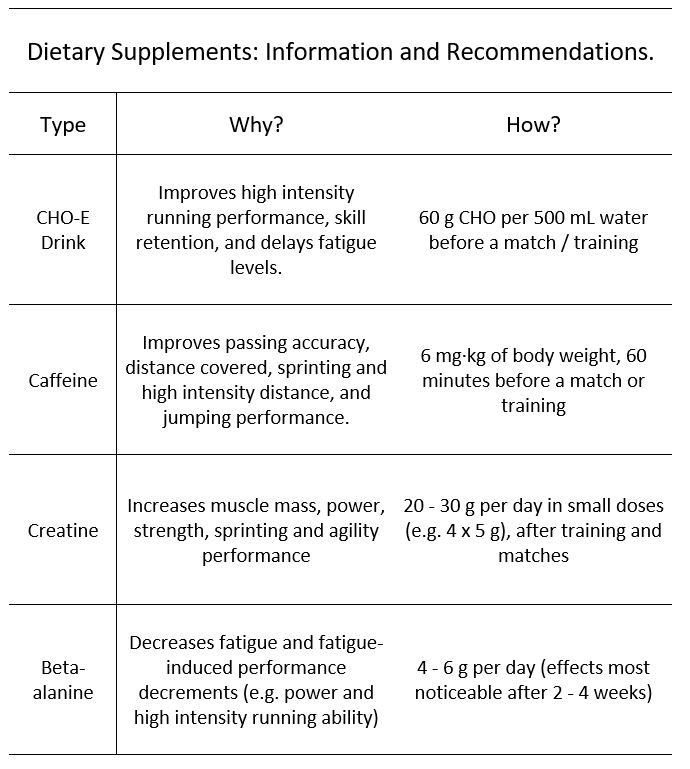
The first supplement from the ‘Sports Foods’ category, is sports drinks, more specifically Carbohydrate-Electrolyte (CHO-E) drinks. These are very common within soccer teams at almost every level of the game, but what is the rationale behind their use, and how should they be used? There have been many studies that look at the effects of CHO-E drinks on soccer performance measures. The idea behind using CHO-E drinks at intervals in soccer matches and training is that they increase CHO availability within the body as it is depleted during exercise. This increased availability means the body can perform at higher levels for longer periods of time as it has more fuel. CHO-E drinks can improve prolonged high-intensity running performance, soccer skill retention, and can delay fatigue during soccer matches and training [53]. It is suggested that a CHO-E drink containing 12% CHO solution (60 g CHO per 500 mL) improves soccer performance from both a skill and physical perspective, compared to electrolyte only drinks.
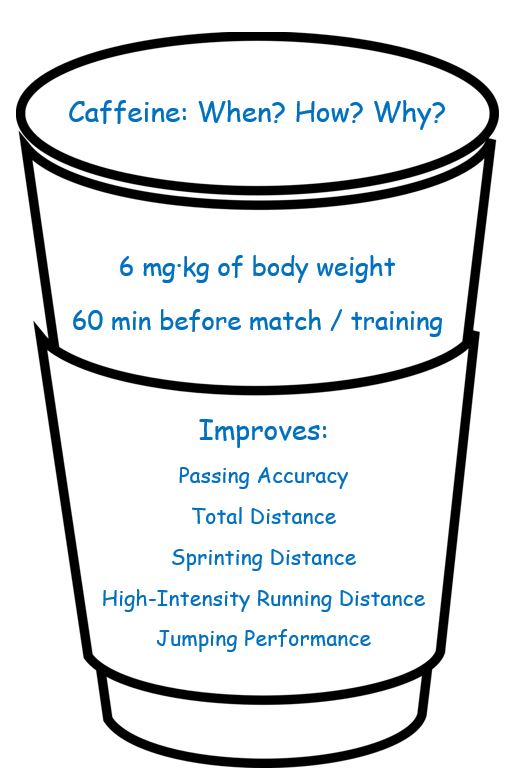
Caffeine falls under the ‘Specific Performance Supplements’ Category of dietary supplements, and is one of the most widely used within sports in general. The International Society of Sports Nutrition found that using caffeine as a supplement can be beneficial for soccer, where activity is prolonged and intermittent [67].
Caffeine is very easy to supplement with as it can be consumed in several ways, whether it be in energy drinks, or hot drinks such as coffee, and is therefore suitable for a variety of player preferences. Caffeine has been shown to improve skill and physical capabilities, with no negative impacts on other performance parameters [45]. This image details caffeine use recommendations for soccer matches, and the parameters that can be improved by doing so.
Another supplement in the ‘Specific Performance Supplements’ category is Creatine. Creatine is a compound stored mostly in skeletal muscle, and plays a role in maintaining levels of ATP in cells that can be used as energy for exercise. Lots of research around creatine use has shown it to increase physical capabilities such as power, strength, muscle mass, and brain performance [22]. Alongside these general physical improvements, creatine supplementation has been shown to improve performance in soccer-specific tests such as dribbling tests, sprinting and endurance tests, jumping tests, and agility in both male and female elite soccer players [41][46][49]. These benefits make creatine (specifically creatine monohydrate) a very popular supplement for elite soccer players [72]. However, like with any supplement there are non-responders, those who do not react in the same way to the supplement, and in these cases, creatine will not always improve performance and should be used accordingly.
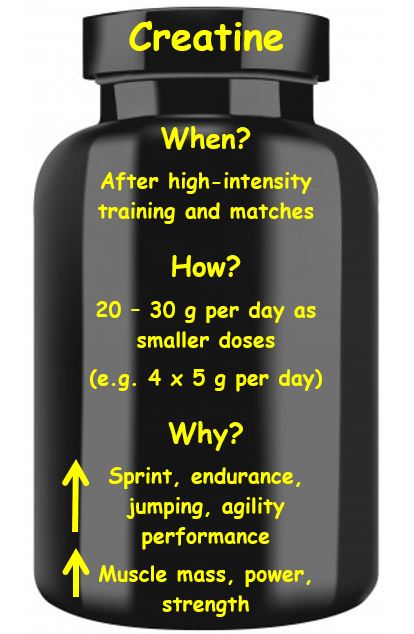
The rationale for creatine use is well understood, and as a result, it’s recommendations for use are well defined. Creatine is most effective when taken after exercise, or after high intensity training and matches for soccer players, and is more effective still when taken with CHO compared to when it is taken alone [9]. The dosages of creatine vary, however as a guide, 20 – 30 g of creatine should be given per day, in smaller doses (e.g. 4 x 5 g per day, or 3 x 10 g per day).
Finally, we will look at Beta-alanine, a supplement in the ‘Medical Supplements’ category. Beta-alanine use is very common in a variety of sports, including soccer. The rationale behind beta-alanine’s use is that it delays the onset of muscle fatigue, and also improves recovery during high intensity exercise [78]. The main effect of beta-alanine supplementation is that it decreases fatigue-induced performance decrements such as power and high intensity running ability. The International Society of Sports Nutrition recommends that 4 – 6 g of beta-alanine should be taken per day, and if taken for at least 2 – 4 weeks will improve exercise performance [71]. The use of beta-alanine may provide not only performance improvements in the form of delaying fatigue, but also allow players to perform a higher volume of training, meaning coaches can overload players and gain greater adaptations.
 Science of Soccer