
Learn how to integrate physical training with technical training to boost performance.
Since the purpose of training is to replicate and exceed match demands, so that players can cope with the demands and perform to the highest level, it is reasonable to think that coaches should prescribe on-field training to players, as this is the most match-specific format. As such, on-field conditioning work can be a great way to promote physiological adaptations, and train in ways that are not possible, or are very difficult, in a gym environment. This section will be split into three separate areas:
- High-Intensity Interval Training
- Sprint Interval Training
- Integrating physical demands and technical / tactical drills using Small Sided Games
Firstly, we will discuss high-intensity interval training (HIIT). This type of training is typically characterised as shown in the table below.
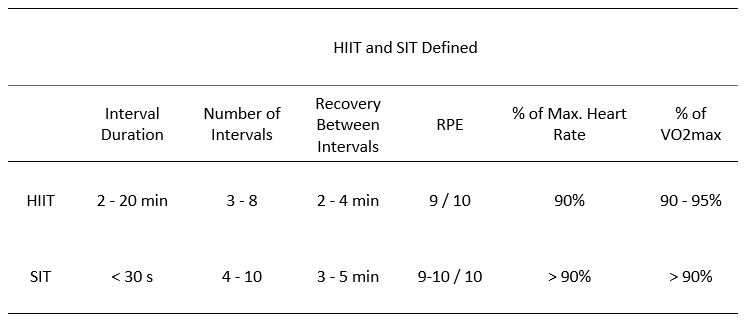
HIIT can be a very useful tool for coaches throughout the season for several reasons. It can be used in pre-season to improve players aerobic fitness as a whole squad, where benchmarks can be set, and the sessions can be easily managed. It can be used during the competitive season to maintain the squad’s fitness levels, while decreasing the external load on players, and thus reducing injury risk, compared to longer duration fitness activities. It can also be useful for players returning from injury, as work, rest, reps and speeds can be individualised to the player and their position. The aim is to achieve the parameters discussed in the table above. If the player has testing data (see testing section for what data can be collected) then coaches can prescribe intervals of, for example, 90 – 95% of velocity at VO2max (vVO2max), as this is much easier to do on field, and with whole squads. See the figure below for an example of how this might look.
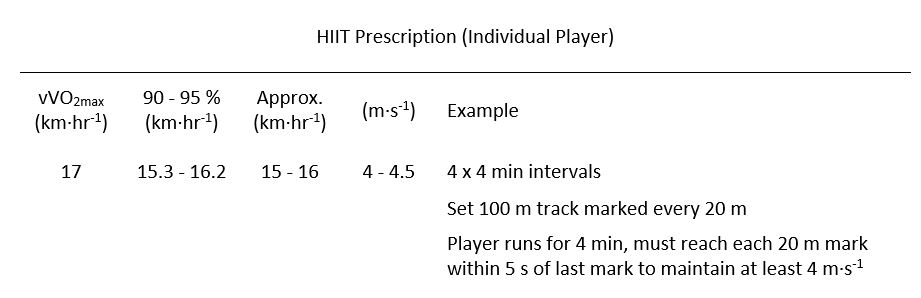
Alternatively, coaches can use RPE to prescribe interval speeds, either on-field, or on a treadmill, as RPE shows good correlation with heart rate during interval exercise [25]; coaches should aim for intervals to be around 17 on the Borg 6 – 20 RPE Scale. There are many benefits of players using HIIT within their training schedules:
Skeletal Muscle Adaptations
- Higher Cell Stress
- Increased Molecular Responses (e.g. increased PGC1-α transcription)
- Increased Mitochondrial Biogenesis
- Increased Capillary Density
Cardiovascular System Adaptations
- Increased Cardiac Output
- Increased Stroke Volume
- Increased Blood Volume
- Improved VO2max
Sprint Interval Training (SIT) is very similar to HIIT in terms of the physiological adaptations it produces, however SIT benefits from also improving sprinting mechanics. As shown in the table above, SIT is programmed slightly differently to HIIT, with intervals being maximum effort for a shorter duration, although we can adapt the principles of SIT to be able to train a whole squad, or just individual players in much the same way as with HIIT. Whether coaches conduct SIT on-field or on a treadmill, the key aspect is to always maintain maximum effort during every interval. Coaches can measure improvements by looking at interval speeds, heart rate, blood lactate concentrations, and power output, for example, and monitor these throughout a training cycle. The table below gives an example of how SIT could be used within a weekly schedule.

SIT training has been shown to provide many benefits to players, including:
- Increased Molecular Responses (e.g. increased PGC1-α transcription)
- Increased Mitochondrial Biogenesis
- Increased Speed, Peak Power Output, VO2max, Time Trial Performance
- Decreased Blood Lactate Concentrations, Time to Set Distances
The main point of both HIIT and SIT is that it maximises cell signalling responses, and thus physiological adaptations, whilst minimising injury risk due to a decreased external load.
Small Sided Games (SSG’s) have recently shown potential to produce the same physiological stimulus as HIIT and SIT within soccer-specific drills, meaning SSG’s are increasingly used within soccer training schedules. With a little bit of understanding, coaches can manipulate the conditions of SSG’s to provide players with physical and technical development, in a much more match-specific format than that of separate physical and technical training. The table below describes how SSG variables can be changed to give coaches specific physical outcomes.
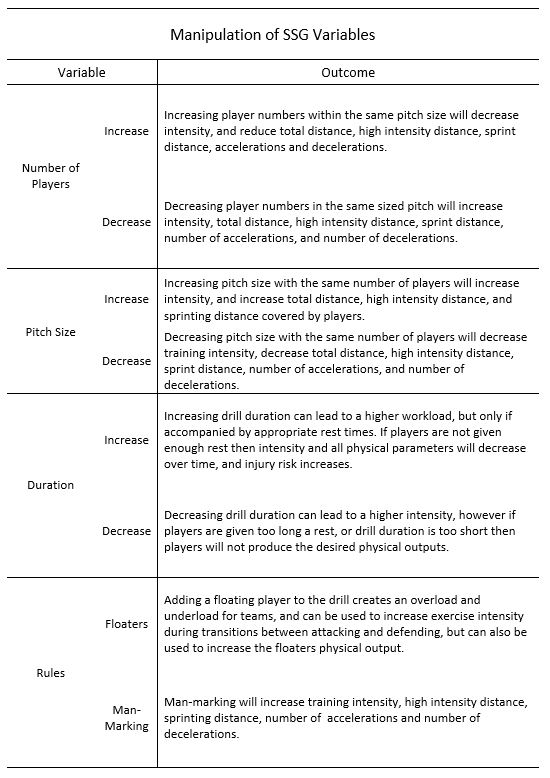
Research has shown that using RPE is an effective measure of exercise intensity of SSG’s within elite soccer [13], meaning we can use RPE, alongside GPS or heart rate measures to accurately determine if training is being optimised.

The main benefit of using SSG’s as a conditioning tool for players, is the match-realistic situations that are presented to players within the drills. This, alongside the simultaneous development of physical and technical attributes, make SSG’s, in their various formats, a very useful tool for coaches to help with on-field player conditioning.
 Science of Soccer