
Learn about the practical ways in which recovery can be enhanced.
Recovery is a vital part of every soccer player’s training schedule, and improvement or maintenance of performance levels hinges on optimising recovery. This is especially important within soccer, as during the season teams can be faced with increasingly demanding and congested match schedules, and therefore players need to be able to recover between each match and training session in order to perform to the highest level every time.
So, what are the goals of recovery, and why is it so important to players?
- Recovery restores physiological and psychological processes after exercise.
- It minimises fatigue and soreness so that later performance is optimised.
- It allows time for physiological adaptations to occur.
- Example:
- Research shows that Rate of Force Development is decreased with higher muscle damage [48].
- Therefore, if the muscle is not able to fully recover, performance is likely to decrease as the muscle is not able to produce the same rates of force.
What are some commonly used recovery techniques in soccer?
- Sleep
- Cold Water Immersion
- Massage
- Stretching
- Foam rolling
- Compression garments
- Active Recovery
- Nutritional substances
While it may seem a trivial strategy when first looked at, the benefits of getting enough sleep should not be dismissed, and they play a huge role in the recovery of soccer players at all levels. With congested, and changing weekly schedules, it is important that players get enough quality sleep each day to optimise recovery and performance.
It has been shown that sleep loss can reduce muscle glycogen content [61], increase muscle soreness [26], reduce memory retention ability [76], and increase inflammation [33], which all negatively impact soccer performance.

Match-related and post-match factors such as caffeine consumption, alcohol and hyperhydration, can all lead to sleep disturbance and should therefore be monitored. It is suggested that, while sleep-wake schedules for whole teams are normally planned, individualising these schedules based on player preferences may be better to ensure good sleep [42].
Cold Water Immersion (CWI) is a technique where the whole body, or parts used during exercise (the legs in soccer) are submerged in cold water for a period of time. The general principles behind CWI as a recovery technique are that the temperature and pressure of the water cause changes in blood flow, skin, core and muscle temperature, metabolic activity in the body, and nerve conduction velocity, which all lead to decreased recovery time and muscle soreness, usually due to decreased swelling and inflammation. CWI has been shown to be better than passive recovery in management of muscle soreness [36], however, it is important to note that studies often lack high levels of reliability, and that CWI is dependent on a dose-response relationship.
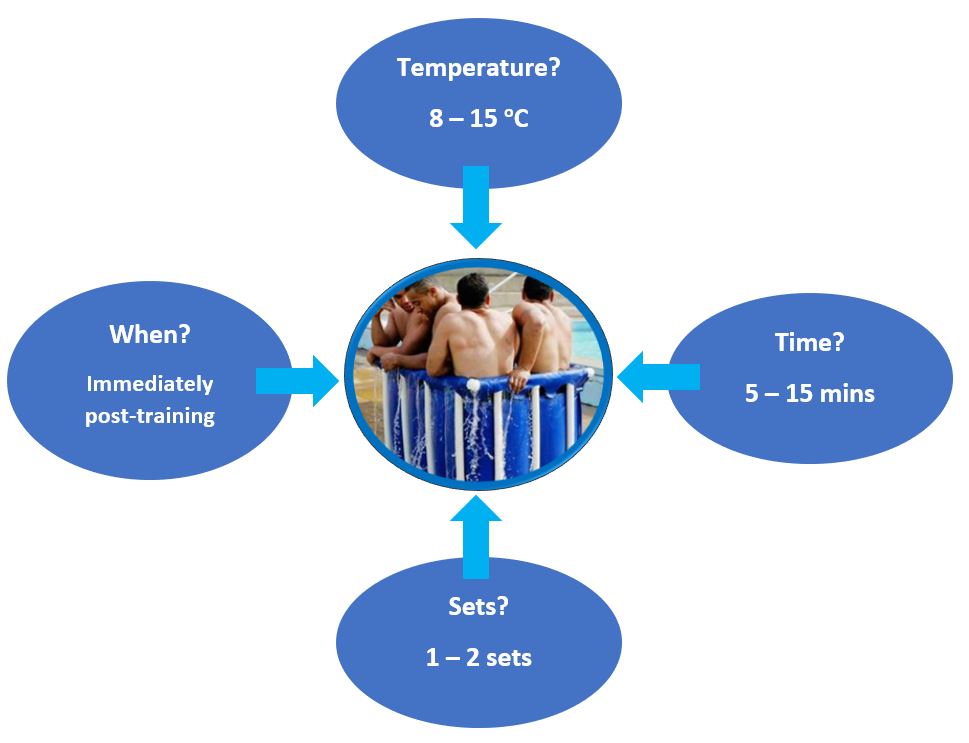
This graphic shows the recommended protocol for CWI based on current research [36]. Overall, whilst there are obvious limitations as to the practicality of CWI, it is an effective recovery tool for soccer teams, especially during congested schedules where recovery is essential.
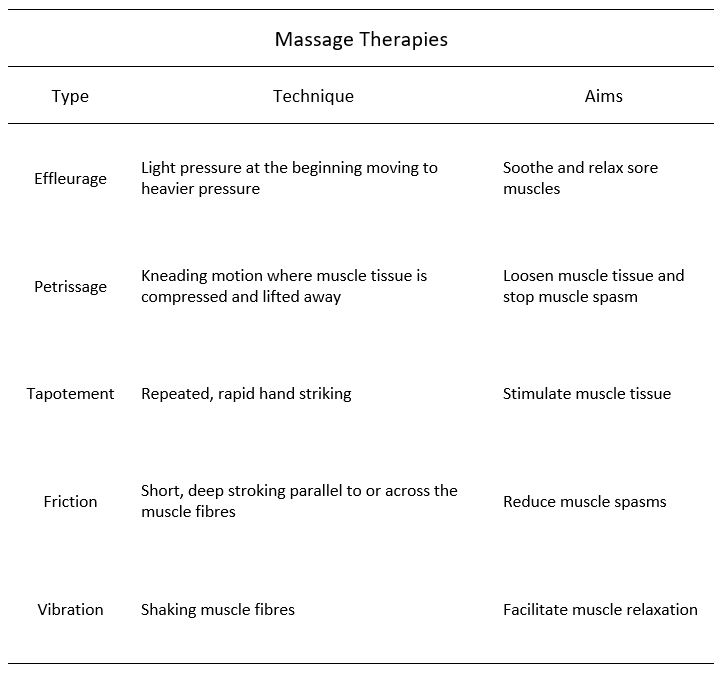
Massage as a recovery strategy comes in many different forms, and a few of these forms are detailed in the table below. Massage is essentially the mechanical manipulation of muscle tissue to promote tissue health. Although the evidence as to the physiological benefits, such as blood flow, lactate removal and hydrogen ion removal, are equivocal and require more research, massage offers many significant psychological benefits to players. Research has found massage to be effective to improve mood state, subjective feelings of muscle soreness, intensity of soreness, and perceptions of overall recovery [42]. Therefore, even though studies do not find significant physiological benefits of massage after global exercises [52], it is a very effective recovery strategy to improve subjective perceptions of recovery, and psychological markers of recovery and readiness.
Stretching and flexibility are one of the most used recovery techniques in soccer, with Premier League clubs dedicating almost 40% of training time to this method. The aim of stretching is to increase range of motion and decrease muscle stiffness. However, when the studies analysing stretching as a recovery technique are reviewed, it is shown that stretching does not improve recovery, and may even harm the recovery process after eccentric exercise [31]. Therefore, attention must be given to the timing of stretching following exercise, and it should not be given as a recovery strategy alone.
Foam rolling is another very commonly used recovery technique for soccer teams, as it is affordable, easy to perform, time efficient, and can be done by whole squads or individuals. This method runs on similar principles to massage in that it aims to loosen and stimulate muscle tissue to speed up recovery. Research has shown that a 20-minute routine of foam rolling post exercise reduces muscle soreness and restores dynamic, power exercise performance faster than if foam rolling is not used [47]. Foam rolling therefore offers a very practical and easy recovery technique for soccer teams to use after training or matches.
Compression garments aim to apply pressure on the lower limbs to increase blood flow to the muscles most used within training and matches. The evidence is still split as to whether they offer any physiological benefit. However, compression garments have been shown to improve players’ feelings of recovery improvement, and may be effective when used after very heavy eccentric exercise to reduce swelling and inflammation in the muscles [42]. Compression garments may be useful to reduce perceptions of muscle soreness, and be an easy to use recovery strategy for soccer teams.
Active recovery, also known as cool-downs or warm-downs, are very commonly used by soccer teams after training and matches, and on recovery days following match days. This type of recovery generally involves low intensity (30 – 60% VO2max) cycling or running for 15 – 30 minutes. Active recovery for > 15 mins can increase blood lactate removal; however, it has also been shown to significantly impair muscle glycogen synthesis [19]. Implementing an active recovery session in the days following a match seems to neither improve nor harm the recovery process and may be a good way to work on tactical aspects of the game, go through post-match analysis, or even help to improve feelings of readiness in players.
 Science of Soccer