
Learn about the detailed context of soccer, and what demands players will face.
This section gives an overview of the match demands of elite soccer, with a detailed analysis and explanation of the physical demands that players will face during matches.
Soccer players can cover more than 11 km of distance during a match, however, soccer match play is extremely variable, and the physical demands that a player will face depend upon many external factors, such as opposition skill level, whether the match is home or away, whether the team is winning, drawing, or losing, even down to which half of the match it is. Therefore, it is important that we understand how these variables can be simplified, understood, and used to inform training.
There are many ways in which we can monitor and study match demands. These can be very practical methods, such as GPS or Heart Rate data, or more scientific methods, such as O2 consumption or Blood Lactate concentrations. We will discuss a range of different approaches, evaluating the pros and cons of each method, and looking at what they can show us about soccer match demands.
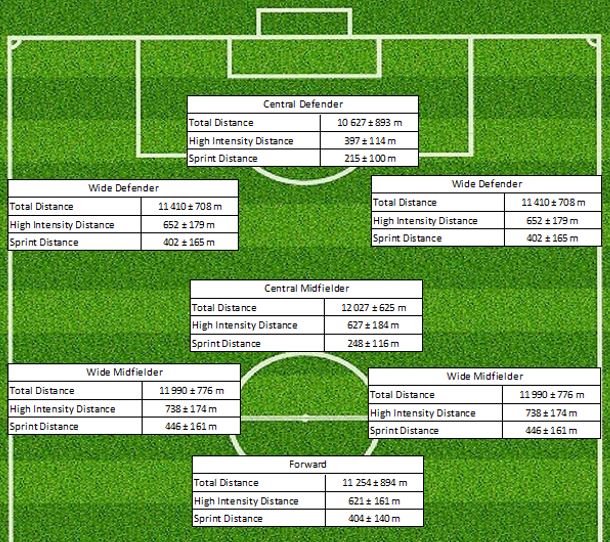
The first, and most basic factor that influences the physical demands of a soccer match is playing position. Research looking at GPS data from match play shows that each playing position has very different demands. For example, central midfielders cover a significantly higher moderate intensity distance and lower sprinting distance during a match, whereas wide midfielders cover significantly more high-intensity distance than any other position during a match [15]. As the main physical aim of training is to replicate and overload the demands of a match, a player’s training demand should be specific to their position so that they can meet and exceed the demands of match play.
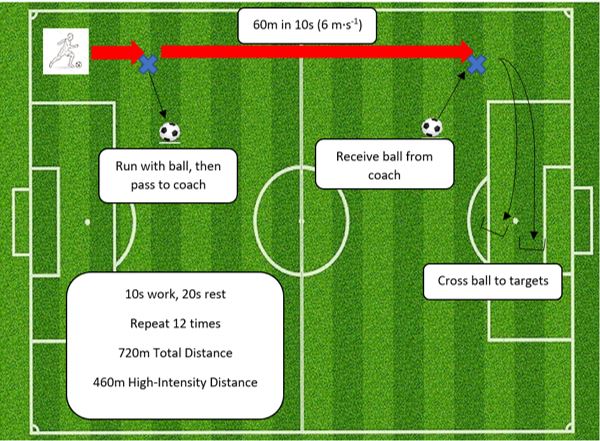
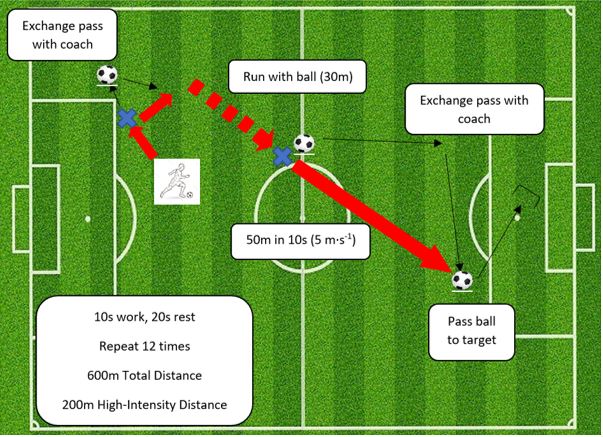
One way that training demands can be individualised to position is by using specific conditioning runs. When using GPS to track match demands, players movement will be split into thresholds. These thresholds are usually the same for all players, however they can be individualised.
Conditioning runs are an effective way to overload match demands in training [5], and we can therefore give players position specific runs, such as those shown in the figure opposite, to replicate match demands.
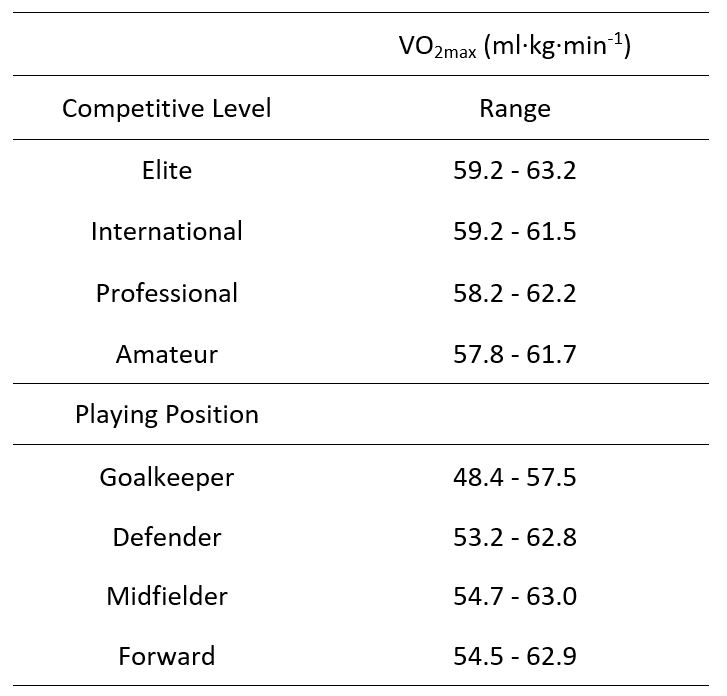
In terms of the more physiological methods to measuring match demands, we can measure using indicators such as Heart Rate and VO2max. VO2max is a measure of the maximum amount of oxygen an individual can utilise during exercise, also referred to as aerobic capacity. Generally, the higher a player’s VO2max, the more aerobically fit they are. This is an important indicator, as research has shown that VO2max is the strongest discriminator between higher and lower level soccer players [62][63]. During a match, players will typically spend 90 minutes at an average of 70% of VO2max, and therefore, it is important that they improve and maintain a high VO2max over the season.
The opposite table shows how VO2max can vary between competitive level and playing position. This shows that the aerobic demands of each playing position also vary, which is important when planning training to meet and exceed match demands.
The table below shows the average values for total distance per match and VO2max for national teams in the 2010 and 2014 World Cup [37].

 Science of Soccer